CHC HS

|
Report No.
|
1701 |
|
Type of audit
|
External Audits |
|
Auditee/Customer
|
CHC HS |
|
Date
|
2020/06/24 |
|
Findings
|
11 |
|
Status
|
Closed |
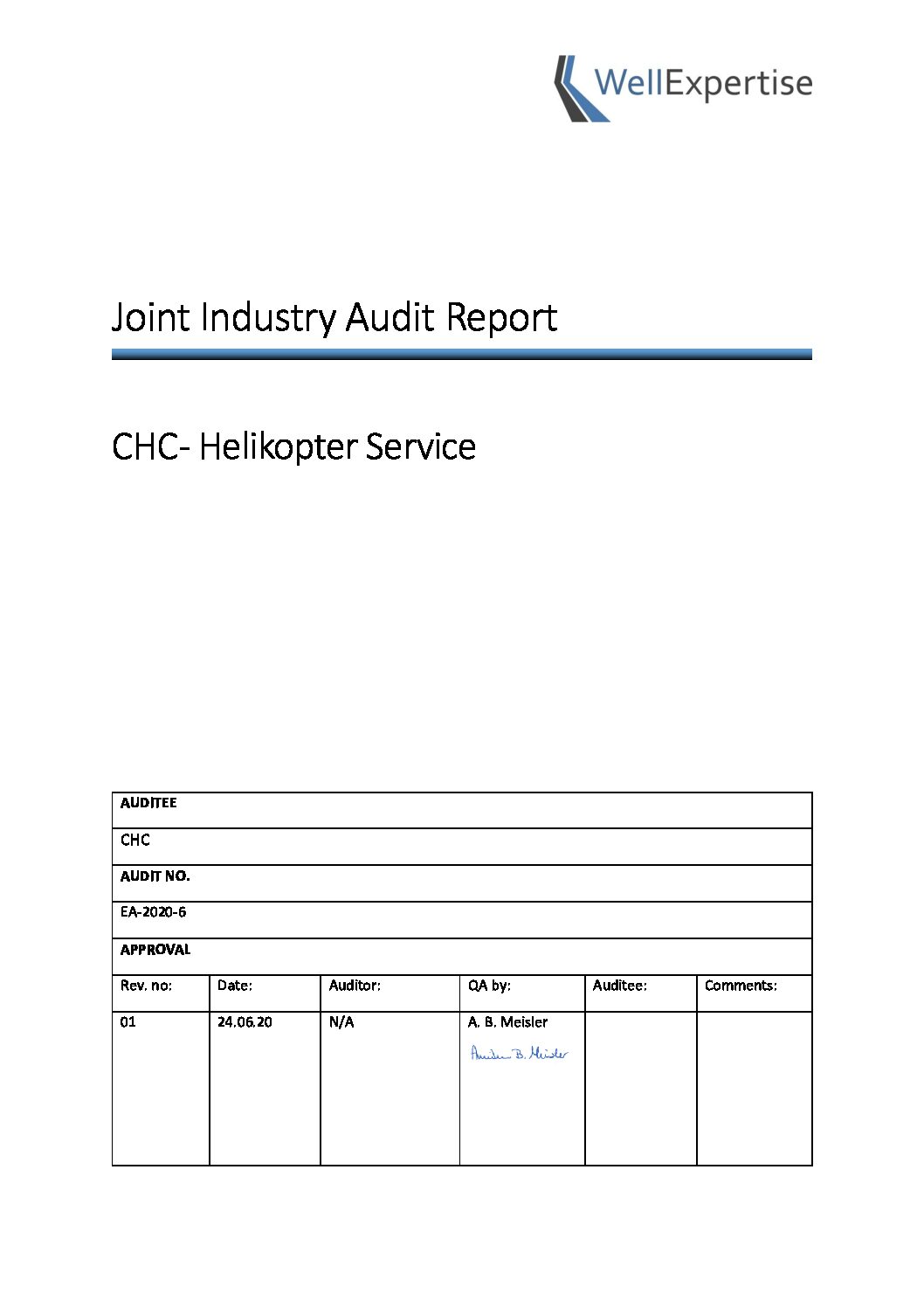
Joint Industry Audit Report-CHC- Helikopter Service
Summary
bases and different aircraft types) and the current COVID-19 challenges, the reporting (incident
reporting and audit findings) has not revealed any major concerns.
Personnel interviewed during the audit expressed a professional attitude and a genuine desire to
seek continuous improvements. The audit team noted many positive aspects:
The Part M CAME has been completely renewed and is recently submitted to the NCAA
for approval.
A reorganising of the Part M department is underway with the aim of increasing capacity
and flexibility.
Part M is in the process of specifying contracts towards HeliOne for each required area.
This is positive for good order and oversight and is in line with the current regulatory
requirements.
Sick leave rates are generally low.
The TRIR (Total Recordable Incident Rate) is low (and have been for some time).
Despite the fundamental solidity CHC HS display there are some general areas worth monitoring:
Due to rightsizing in a challenging and competing marketspace combined with applied
principles of seniority, the company demographic reflects an ageing technical and
operational workforce driving cost and leaving the company susceptible to “generation
gaps” unless controlled.
Multiple CHC HS staff postholders hold significant positions/roles within corporate CHC,
this is especially true for the accountable manager who is also responsible for the UK,
Irish, and Dutch operations. One should ensure that the workload is manageable, and
that Norwegian operation is sufficiently prioritized for effective and safe operations and
that the accountable manager is delegated adequate authority at all time.
Findings
-
Non-Conformity
 Closed
Deadline was:Responsibilities concerning the ERP (overall
responsibility, responsibility for the manual, for
the practical execution of exercises etc.) should
be clearly stated in the manuals, or one of the
manuals.
(ref: the ERP and SC&M Manuals) -
Non-Conformity
Closed
Deadline was:An overall analysis of the data derived from the
internal and external audits should be
undertaken in order to assess the suitability and
efficiency of the Quality (Safety & Compliance)
monitoring system and function.
(ref: ISO 9001:2015) -
Non-Conformity
Closed
Deadline was:The HESS Advisors responsibilities concerning
security should be stated in the HESS Manual.
(ref: the CHC HS HESS manual) -
Non-Conformity
Closed
Deadline was:A contract stating the relation between Securitas
and CHC HS could not be presented during the
audit.
(ref: EASA ORO.GEN 205) -
Non-Conformity
Closed
Deadline was:The completed MoC concerning the Ground
Operations restructure (outsourcing) could not
be presented in the audit.
(ref SC&M Manual) -
Non-Conformity
Closed
Deadline was:The management of risk is described in different
processes. It is hard to see from the SC&M
Manual how these different risk management
descriptions come together in the risk register
and the current bow tie, given those are the two
ultimate (or penultimate) expressions of the
current risk picture in the company. In sum it
may be difficult to secure that all risks are
manged as intended in ORO.GEN 200.
(ref: EASA ORO.GEN 200) -
Observation
Closed
Deadline was:We register that the climate for cooperation between
CHC HS and Bristow is good. However, there is
something to be desired concerning the timely sharing of
information between the companies in the cases of
serious events. We suggest the companies look into this
for the purpose of improving non-competitive information
sharing. -
Observation
Closed
Deadline was:The yearly performance review had not been completed
for all technicians at some of the bases. -
Observation
Closed
Deadline was:The CHC MOE does not mention any training
requirement for the handling of parts in relation to ESD
(Electrostatic Discharge). -
Observation
Closed
Deadline was:The NP Part M will revert back to the Common Audit on
why there is a sudden dip in MEL statistics for May. We
also observe an increase in MEL use before May, but
none of the other relevant KPIs (robberies, MDR)
indicate anything in particular pointing to any problems
related to the lack of parts. -
Observation
Closed
Deadline was:In different MoM from different FDM meetings it is hard
to see concrete actions and also whether the different
outputs are being tracked in the management (SQID)
system.
Additional Documentation


New Audit Report
\n
CHC HS
|
Report No.
|
1701 |
|
Type of audit
|
External Audits |
|
Auditee/Customer
|
CHC HS |
|
Date
|
2020/06/24 |
|
Findings
|
11 |
|
Status
|
Closed |
Joint Industry Audit Report-CHC- Helikopter Service
Summary
bases and different aircraft types) and the current COVID-19 challenges, the reporting (incident
reporting and audit findings) has not revealed any major concerns.
Personnel interviewed during the audit expressed a professional attitude and a genuine desire to
seek continuous improvements. The audit team noted many positive aspects:
The Part M CAME has been completely renewed and is recently submitted to the NCAA
for approval.
A reorganising of the Part M department is underway with the aim of increasing capacity
and flexibility.
Part M is in the process of specifying contracts towards HeliOne for each required area.
This is positive for good order and oversight and is in line with the current regulatory
requirements.
Sick leave rates are generally low.
The TRIR (Total Recordable Incident Rate) is low (and have been for some time).
Despite the fundamental solidity CHC HS display there are some general areas worth monitoring:
Due to rightsizing in a challenging and competing marketspace combined with applied
principles of seniority, the company demographic reflects an ageing technical and
operational workforce driving cost and leaving the company susceptible to “generation
gaps” unless controlled.
Multiple CHC HS staff postholders hold significant positions/roles within corporate CHC,
this is especially true for the accountable manager who is also responsible for the UK,
Irish, and Dutch operations. One should ensure that the workload is manageable, and
that Norwegian operation is sufficiently prioritized for effective and safe operations and
that the accountable manager is delegated adequate authority at all time.
Findings
-
Non-Conformity
Closed
Deadline was:Responsibilities concerning the ERP (overall
responsibility, responsibility for the manual, for
the practical execution of exercises etc.) should
be clearly stated in the manuals, or one of the
manuals.
(ref: the ERP and SC&M Manuals) -
Non-Conformity
Closed
Deadline was:An overall analysis of the data derived from the
internal and external audits should be
undertaken in order to assess the suitability and
efficiency of the Quality (Safety & Compliance)
monitoring system and function.
(ref: ISO 9001:2015) -
Non-Conformity
Closed
Deadline was:The HESS Advisors responsibilities concerning
security should be stated in the HESS Manual.
(ref: the CHC HS HESS manual) -
Non-Conformity
Closed
Deadline was:A contract stating the relation between Securitas
and CHC HS could not be presented during the
audit.
(ref: EASA ORO.GEN 205) -
Non-Conformity
Closed
Deadline was:The completed MoC concerning the Ground
Operations restructure (outsourcing) could not
be presented in the audit.
(ref SC&M Manual) -
Non-Conformity
Closed
Deadline was:The management of risk is described in different
processes. It is hard to see from the SC&M
Manual how these different risk management
descriptions come together in the risk register
and the current bow tie, given those are the two
ultimate (or penultimate) expressions of the
current risk picture in the company. In sum it
may be difficult to secure that all risks are
manged as intended in ORO.GEN 200.
(ref: EASA ORO.GEN 200) -
Observation
Closed
Deadline was:We register that the climate for cooperation between
CHC HS and Bristow is good. However, there is
something to be desired concerning the timely sharing of
information between the companies in the cases of
serious events. We suggest the companies look into this
for the purpose of improving non-competitive information
sharing. -
Observation
Closed
Deadline was:The yearly performance review had not been completed
for all technicians at some of the bases. -
Observation
Closed
Deadline was:The CHC MOE does not mention any training
requirement for the handling of parts in relation to ESD
(Electrostatic Discharge). -
Observation
Closed
Deadline was:The NP Part M will revert back to the Common Audit on
why there is a sudden dip in MEL statistics for May. We
also observe an increase in MEL use before May, but
none of the other relevant KPIs (robberies, MDR)
indicate anything in particular pointing to any problems
related to the lack of parts. -
Observation
Closed
Deadline was:In different MoM from different FDM meetings it is hard
to see concrete actions and also whether the different
outputs are being tracked in the management (SQID)
system.
Additional Documentation